
Growth Mindset
A growth mindset is the belief that abilities and intelligence can be developed through dedication, effort, and learning. This approach encourages resilience, curiosity, and a love for challenges—key ingredients for lifelong success. Whether you’re a parent supporting your child, a student striving for improvement, or an educator setting expectations, adopting a growth mindset helps foster confidence and perseverance. These documents—Developing a Growth Mindset, Parent Information Growth Mindset, Mindset for Success Tips, and Growth Mindset Expectations—offer practical strategies, insights, and guidance to help everyone in the school community cultivate a mindset that embraces growth, effort, and continuous learning.
Please click on the links below to read our Growth Mindset documents:
Growth Mindset Resources
Multi-tasking Experiment
The research: How mindset affects learning
Children who understand that the brain can get smarter—who have a growth mindset—do better in school because they have an empowering perspective on learning. They focus on improvement and see effort as a way to build their abilities. They see failure as a natural part of the learning process. In contrast, students who have a fixed mindset—those who believe that intelligence is fixed—tend to focus on judgment. They’re more concerned with proving that they are smart or hiding that they’re not. And that means they tend to avoid situations in which they might fail or might have to work hard.
Many studies show that children who have a growth mindset respond differently in challenging situations and do better in school over time.
The InnerDrive Messy Desk Experiment
Nussbaum: Mindset and seeking feedback
In another study, researchers were interested in the kind of feedback people would seek out after they struggled. Researchers gave participants a difficult test and then told the participants that they hadn’t done well on the test. Then, they gave them a choice: Did they want to look at the tests of people who had done worse than them or the tests of people who had done better? People with a growth mindset chose to learn from people who had done better than them. But people with a fixed mindset seemed more interested in making themselves feel better. They looked at the tests of people who had done worse
The Coin Toss Prediction –
Part 1
Blackwell: Growth mindset leads to better math grades
A study with middle school students looked at the impact of fixed versus growth mindsets on achievement in math—a subject that many students find challenging. Students with a growth mindset earned higher math grades over time compared to students with a fixed mindset.
Blackwell, Trzesniewski, & Dweck (2007) [View Source]
The Coin Toss Prediction, Famous Failures –
Part 2
Romero: Growth mindset and advanced class placement
Mindsets have also been shown to predict who takes more advanced courses. In a study with middle school students, those with a growth mindset were more likely to be placed into advanced math over time.
Romero et al. (2014) [View Source]
Fold a T-shirt like an expert
Mangels: Mindset affects learning from mistakes
A growth mindset focuses students on learning, rather than simply performing well. You can see this when you look inside the brain. In one study, scientists brought people into the lab. They put an EEG cap on their heads to measure how active their brains were. While scientists were measuring brain activation, they asked participants a trivia question. Participants gave their answer, and then the scientists told them if they were right or wrong. In other words, they were given performance feedback. The scientists found that the participants with a growth mindset and with a fixed mindset both had active brains when they were told whether they were right or wrong. So all participants paid attention to the performance feedback. What’s interesting is what happened next. Participants were told the correct answer. And again, the scientists looked at how active the participants’ brains were. The brains of people with a growth mindset were significantly more active than the brains of people with a fixed mindset. People with a fixed mindset were tuning out after they found out if they were right or wrong; they weren’t interested in learning the correct answer. At the end of the study, the scientists gave participants a pop quiz with the same trivia questions. Not surprisingly, the people with a growth mindset did better.
Mangels et al. (2006) [View Source]
The InnerDrive Four Cup Experiment
Mueller & Dweck: How praise affects children’s behavior
This video –The Effect of Praise on Mindsets– is from the book, “Mind in the Making: The Essential Life Skills Every Child Needs”.
Mueller & Dweck (1998) [View Source]
What is a growth mindset
Gunderson et al.: Process praise and mindset development
In another study, researchers observed how parents praised their children at the ages of 1 to 3. Five years later, the researchers measured the children’s mindsets. They found that the more parents used process praise when their children were 1 to -3-years-old, the more likely those children were to have a growth mindset 5 years later.
Gunderson et al. (2013) [View Source]
Which Mindset is Right?
Activity: Model making mistakes
Modeling a growth mindset means being willing to try hard even when failure is likely because that’s how growth happens. For example, parents should try to get excited when their children make mistakes because these mistakes can reveal important conceptual gaps that should be filled. When adults get excited about the learning that mistakes can facilitate, children start to think of mistakes as a natural part of the learning process. This leads to a few important changes in learning behavior:
- Children become less likely to try to “sweep mistakes under the rug” because they stop thinking of them as something to be ashamed of.
- Children stop avoiding challenging work just because it could mean making more mistakes.
Three ways parents can instill a growth mindset
Action Ideas
- Make mistakes in front of your kids, have a positive reaction to those mistakes, and openly reflect on what could be learned from the mistake. Try to show that it’s all about learning, not about being right.
- At the dinner table, talk about a time that you struggled with something and how hard it is and how you overcame it. Then ask your kids if there’s anything they struggled with, how they overcome it, and what they learned from the experience.
- Get excited when your child makes a mistake and help her think through what could be learned from it. Even mistakes that seem careless can be good learning opportunities. For example, if your child forgot to study enough for an important test, it might be an opportunity to learn about prioritization and to-do-lists.
Activity: Use growth mindset language
Everyone falls into fixed mindset thinking sometimes. The first step toward fostering a growth mindset in our children is to become aware of language that signals one mindset or the other.
Here are some questions to think about:
- How often do you notice and praise effort, strategies, and progress?
- What thoughts did you have this week when your child struggled? How could you frame their struggle in a growth mindset way by helping them understand that this is when their brain is growing most?
- What thoughts did you have when your child excelled? How could you frame their success in a growth mindset way, e.g., by talking about the process that went into their success?
- What kinds of fixed and growth-mindset statements did your child make?
Action Ideas
- When you hear or provide praise, ask yourself “What is being praised?” Is it effort, strategy, persistence, focus, and improvement, or does it sound more like a fixed trait or ability?
- When you or your child makes a mistake, ask yourself “How does my reaction influence my child’s future behavior?” Does it encourage learning and growth, or does it encourage them to avoid challenges in the future?
- When something you or your child says or does signals a fixed or a growth mindset, write it down! You may be surprised how often mindset statements come up. Keep a chart on your fridge for a week then see if it changes at some later time.
- Use the Raise the Bar Parents conversation tracker to schedule some time to talk about your child’s effort and progress this month.
Activity: Explain how practice rewires the brain
Numerous studies now show that people become more likely to adopt a growth mindset if they learn about the scientific evidence for the brain’s ability to rewire itself through practice. One way to foster a growth mindset in your child is to share this evidence with them.
Action Ideas
- When you’re at the dinner table or driving somewhere together, explain to your child that you learned that the brain can rewire itself and become smarter when people learn new things and challenge themselves!
- Tell them a little bit about what you have read, or show them one of these videos.
- Ask your child where in their life they use, or could use, a growth mindset.
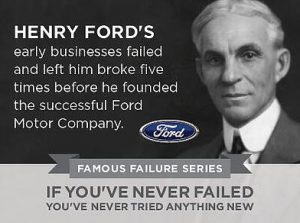
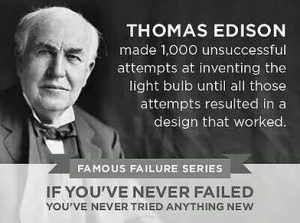
Famous Failure